
The Challenge: Terminology Chaos
In complex information environments, inconsistencies slow down producers and consumers. One person describes something as Artificial Intelligence, another uses Machine Learning for the same thing. They argue over terminology, and their readers are confused.
Know Vocabularies solves this by giving you a central platform to establish, manage, and enforce a clean, preferred lexicon from day one.

Why Use KnoW Vocabularies?
- Accelerate Literature Reviews: Surface and standardize hidden themes across large volumes of text in minutes.
- Universal Data Compatibility: Inject your structured metadata directly into your existing analytical pipelines using platform-agnostic data formats.
- Ensure Data Interoperability: Harmonize your team's vocabularies with zero setup, installation, or upfront costs.

About KnoW Vocabularies
Core Features
Automated Term Extraction & Use Analysis
- Stop building your vocabularies completely from scratch. KnoW Vocabularies jumpstarts your taxonomy by pulling candidate terms directly from your existing documentation.
- Term Use Analysis: check usage of your vocabulary terms
- Web Pages: Point the tool at a URL to extract the most relevant keywords, concepts, and frequently used terms, or analyse their use.
- Documents: Upload Microsoft Word (.docx) files, guidelines, or legacy standards documents to surface latent metadata instantly.
Streamlined Vocabulary Management
- Candidate Review Pipeline: Easily promote extracted keywords into your official vocabulary list with a single click.
- Maintain full control over your authorized terms with a clean, distraction-free interface.
- Establish preferred definitions: Assign clear definitions, scope notes, and administrative metadata to every term to ensure correct application.
- Check consistency of use: Review material produced by your teams to ensure they comply with the definitions.
- Follow industry practice: Review external material to ensure you use terms in ways that people understand.
Collaborative Working
- Multiple team members can work at once on the same vocabulary
- They can see each others' work as it proceeds in real time
- You can give different access permissions to people with different roles (Editor, Reviewer, Authoriser . . )
- You can change team membership and roles as people join, leave, and gain new skills.
Seamless Import, Export & Integration
- Your vocabulary shouldn't live in a silo. KnoW Vocabularies plays nicely with your existing software stack.
- Universal Formats: Import legacy spreadsheets or export your clean vocabularies into developer-friendly formats like JSON and CSV.
- Ready for Downstream Systems: Feed your standardized lists directly into Content Management Systems (CMS), Digital Asset Management (DAM) platforms, and research databases.
Key Benefits
Bridge the Gap from Text to Taxonomy
- Turn unstructured web pages and Word documents into organized, actionable reference data in minutes instead of days.
Enforce Consistency
- Eradicate meaning drift by using terms consistently across your systems.
Boost Content Discoverability
- Consistent use of key terms helps users and search engines find the exact documents, research papers, or digital assets they need on the first try.
Low Friction, High Speed
- Built specifically for teams who need to deploy a reliable vocabulary fast, without the overhead of heavyweight semantic systems.
Whom We Serve
We meet the needs of anyone who uses controlled vocabularies for precise use of words in information management. In particular, KnoW Vocabularies helps database administrators, standards developers, and researchers enforce data integrity and eliminate human error without the overhead of ontology software.
Without a centralized system, maintaining consistency becomes impossible. This lack of standardization leads to:
- Costly Data Silos: DBAs struggle to align data dictionaries, resulting in broken integrations and dirty data.
- Unproductive Delays: Standards developers face lengthy review cycles because conflicting or ambiguous phrasing slips into drafts.
- Wasted Research Hours: Researchers waste critical time manually cross-referencing literature to ensure conceptual alignment.
KnoW Vocabularies solves this by creating an automatically enforceable terminology repository. It eliminates the manual labor of building taxonomies and replaces spot-checking with automated compliance, ensuring that how you defined a term is exactly how it is used in practice.
Database Administrators
Clean up your metadata. Stop pollution before it hits production schemas.
For Database Administrators (DBAs) and systems integration engineers, keeping metadata clean is a constant battle. Minor variations in user tags, mismatched naming conventions, and unchecked descriptions infect database tables and hinder processing and reporting operations.
KnoW Vocabularies gives you a lightweight, no-code system to curate, lock down, and maintain authoritative reference lists—without the need for full-scale Master Data Management (MDM) software. You can rapidly build consistent data dictionaries and metadata schemas from legacy documentation.
Example Workflow: Fixing User-Generated Tag Pollution
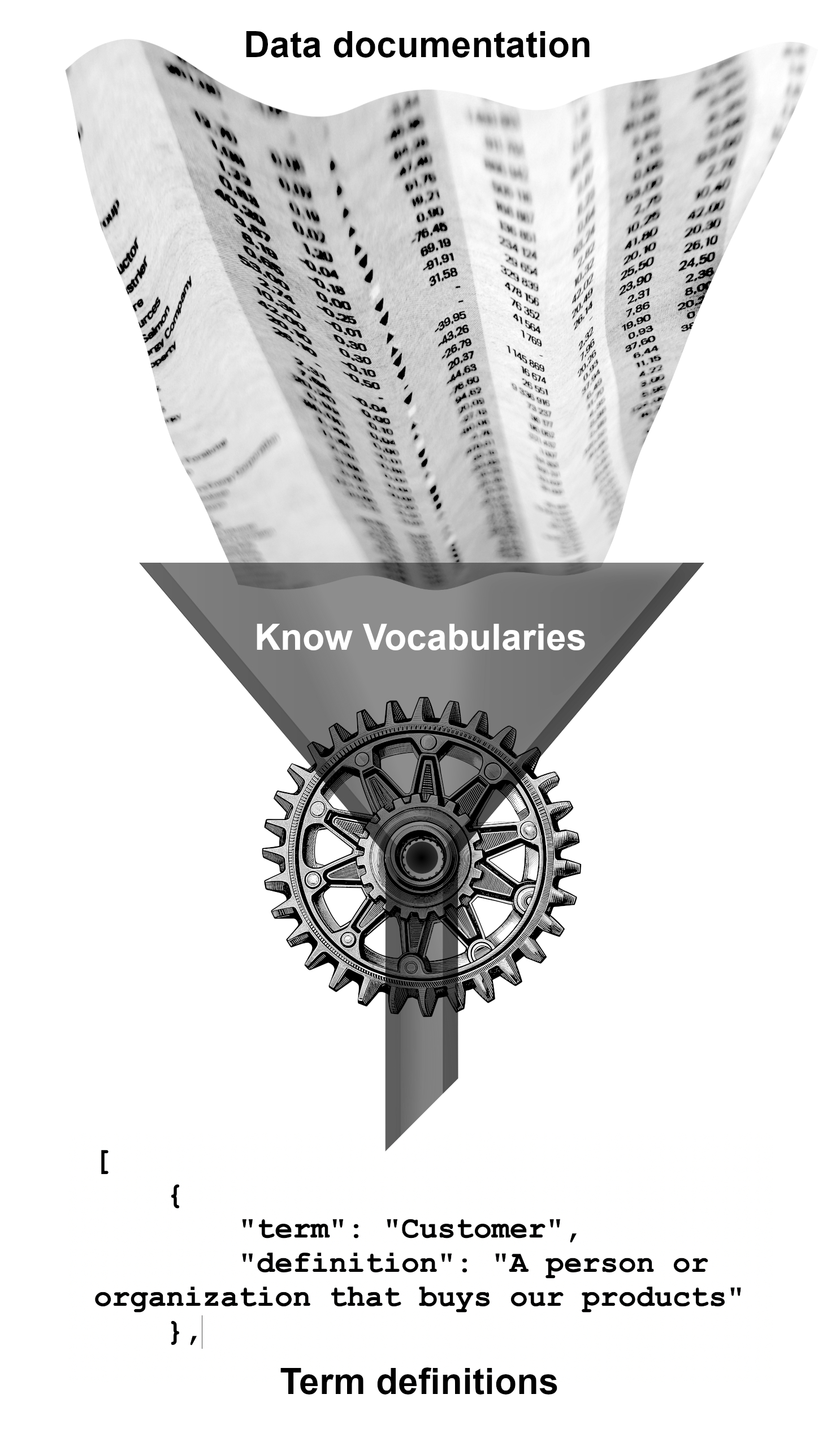 Imagine a multi-system enterprise platform where users manually tag support tickets, product categories, or asset types. Over time, the lookup tables melt into chaos: AI, Artificial-Intelligence, artificial intelligence, and Machine Learning are all used interchangeably.
Here is how a DBA solves this using Know Vocabularies:
1. Harvest & Audit Existing Phrases
Instead of spending hours writing SQL queries to group and deduce variations, you feed your current public documentation, internal system glossaries, or data dictionary web pages directly into the Intelligent Term Extraction engine. The system strips the noise and extracts the core candidate strings into a clean review workspace.
2. Curate the Controlled Vocabulary
In a secure editing interface, you quickly prune the candidate list. You promote the exact preferred terms, add administrative scope notes detailing where and how they should be mapped, and officially approve the result.
3. Establish Lifecycle Safeguards
As your platform architecture evolves, business definitions change. Rather than deleting old terms and definitions and risking breaking historical relational integrity, you mark their entries as Deprecated. This signals to your development team that these are legacy terms and must be blocked from future use.
4. Export Developer-Ready Configurations
Once your reference list is locked down, you hit export.
- JSON Payload: Hand a lightweight, clean JSON array straight to your developers to back front-end form validation dropdowns or API request validators. Modern coding assistants can read JSON and enable developers to deliver working software in double-quick time.
- Universal CSV: Import a structured spreadsheet straight into your database to instantly refresh vocabulary tables.
Key Technical Benefits for Systems Admins
- Lightweight Validation Asset: Create reliable reference tables that support clean data ingestion without setting up heavy graph databases or ontology tooling.
- Safer Schema Maintenance: Use explicit Active/Draft/Deprecated statuses to manage the lifecycle of your core terms, preventing broken dependencies down the line.
- Bridge the Gap to Non-Technical Staff: Let data stewards or content managers handle the manual definition editing in an intuitive UI, freeing up engineering time while you retain final control over the CSV/JSON exports.
Standards Developers
Accelerate consensus. Build, review, and lock down technical terminology.
For standards bodies, regulatory writers, and industry consortia, compiling a harmonized vocabulary from scratch is a massively restrictive bottleneck. Reviewing definitions within and across working groups, tracking draft changes, and aligning technical terminology manually usually results in seemingly endless discussion and argument.
Know Vocabularies gives your committees a lightweight, no-code workspace to ingest draft documentation, harvest candidate terms, and establish an official, audited vocabulary—without the steep learning curve of complex ontology software. You can enforce precise language across massive multi-author specifications to prevent ambiguity.
Example Workflow: Moving from Draft Text to an Approved Standard
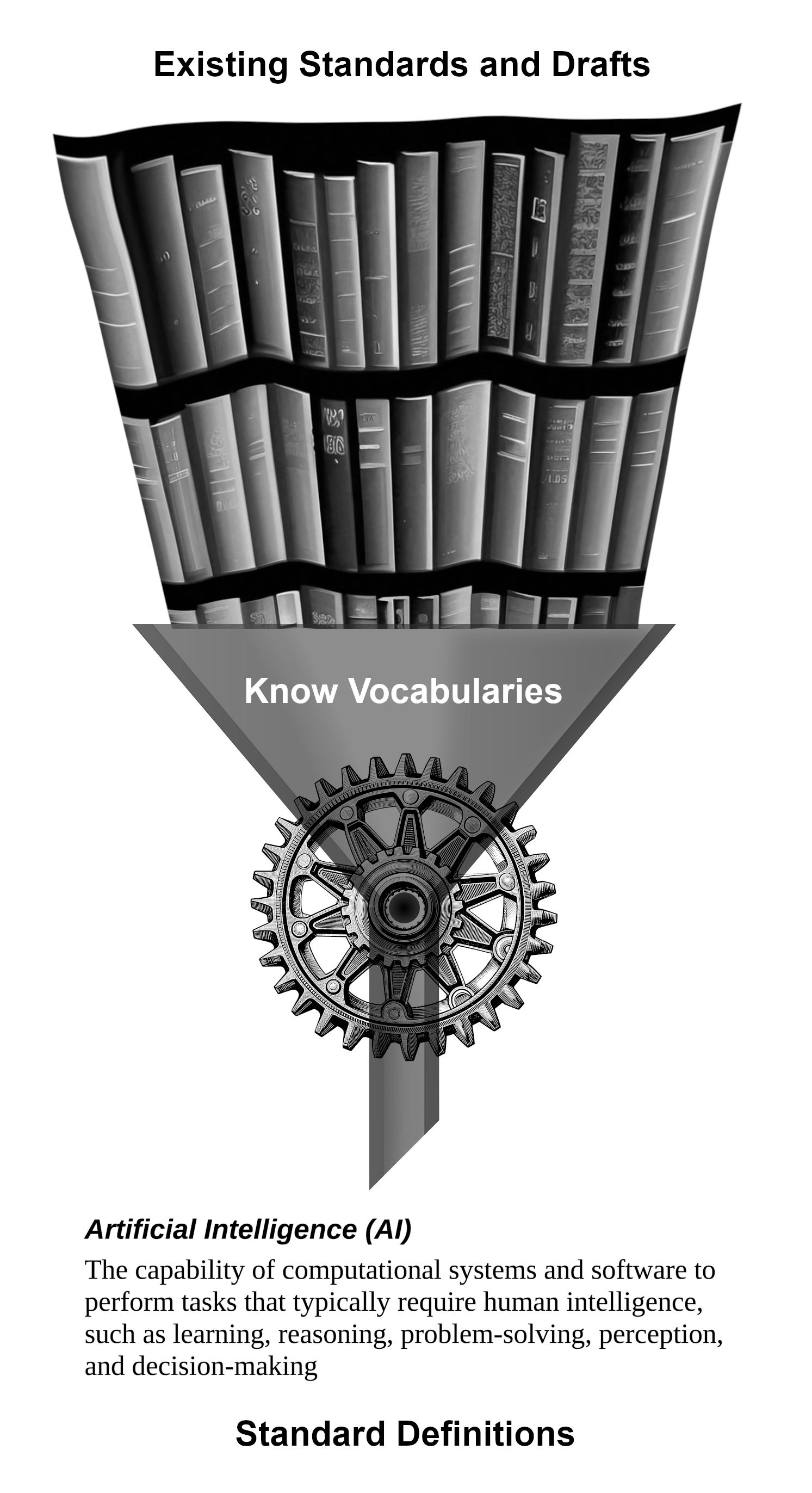 Imagine an international working group tasked with publishing a new technical specification. Multiple contributors submit drafts, leading to overlapping terminology: one section uses Grid-connected, another says On-grid, and a third uses Grid-tied.
Here is how a standards developer standardises this using Know Vocabularies:
1. Automatically Harvest Terminology
Instead of reading through hundreds of pages of text to manually highlight technical terminology, your committee feeds working draft documents (.docx) or public regulatory web pages straight into the Intelligent Term Extraction engine. The system automatically identifies and extracts key phrases and candidate concepts into a clean staging area.
2. Streamline the Review Pipeline
In a secure, distraction-free interface, your committee can easily and collaboratively audit the extracted terms. They prune away irrelevant and unimportant entries and promote the exact preferred terms (e.g., locking down Grid-Connected Systems), with their agreed definitions, into an official vocabulary. They can add administrative metadata and explicit scope notes.
3. Publish and Maintain with Confidence
Once consensus is reached, you lock down the list and export the final vocabulary.
- Definitions Section: The important definitions can be copied and pasted into your document production system to create the formal list of definitions that is a key component of any standard
- Index: A report on use in the standard of the important definitions and other key phrases can make light work of creating an Index. Indexes are of great use to readers, but notoriously laborious to build by hand.
- Track Lifecycles: When a future revision of the standard retires a term, simply mark it as Deprecated. This preserves historical data for legacy compliance while signaling to the industry that the term is no longer active.
Key Operational Benefits for Standards Bodies
- Faster Time-to-Publication: Cut down the weeks spent manually compiling and formatting glossary tables from text drafts.
- Audit-Ready Governance: Use clear Active, Draft, and Deprecated status tracks to manage the precise lifecycle of your consensus-based terms over successive document versions.
- Built for Non-Technical Contributors: Enable subject matter experts and committee members to collaborate inside an intuitive web interface, removing the need for specialized database or coding knowledge.
Researchers
Easily map conceptual frameworks and ensure uniform terminology across complex, cross-disciplinary studies.
For researchers at the leading edge, appropriate terminology often does not exist, and has to be created. Different researchers propose different terms and definitions for new concepts. But few research areas are "green fields": there are existing research papers to build on, and it is important to be consistent with them. Building a solid common vocabulary requires careful consideration but, without one, researchers cannot communicate effectively with each other or to their audience.
KnoW Vocabularies gives research teams a collaborative workspace in which they can easily compile, review, and lock down technical terminology, and develop a consensus-based vocabulary. You can generate a unified phrasebook or reference list from existing papers, proposals, and reviews, add new terms to it, and ensure multiple independent researchers describe ideas in the exact same way.
Example workflow: building a term dictionary to align data entry by co-operating researchers
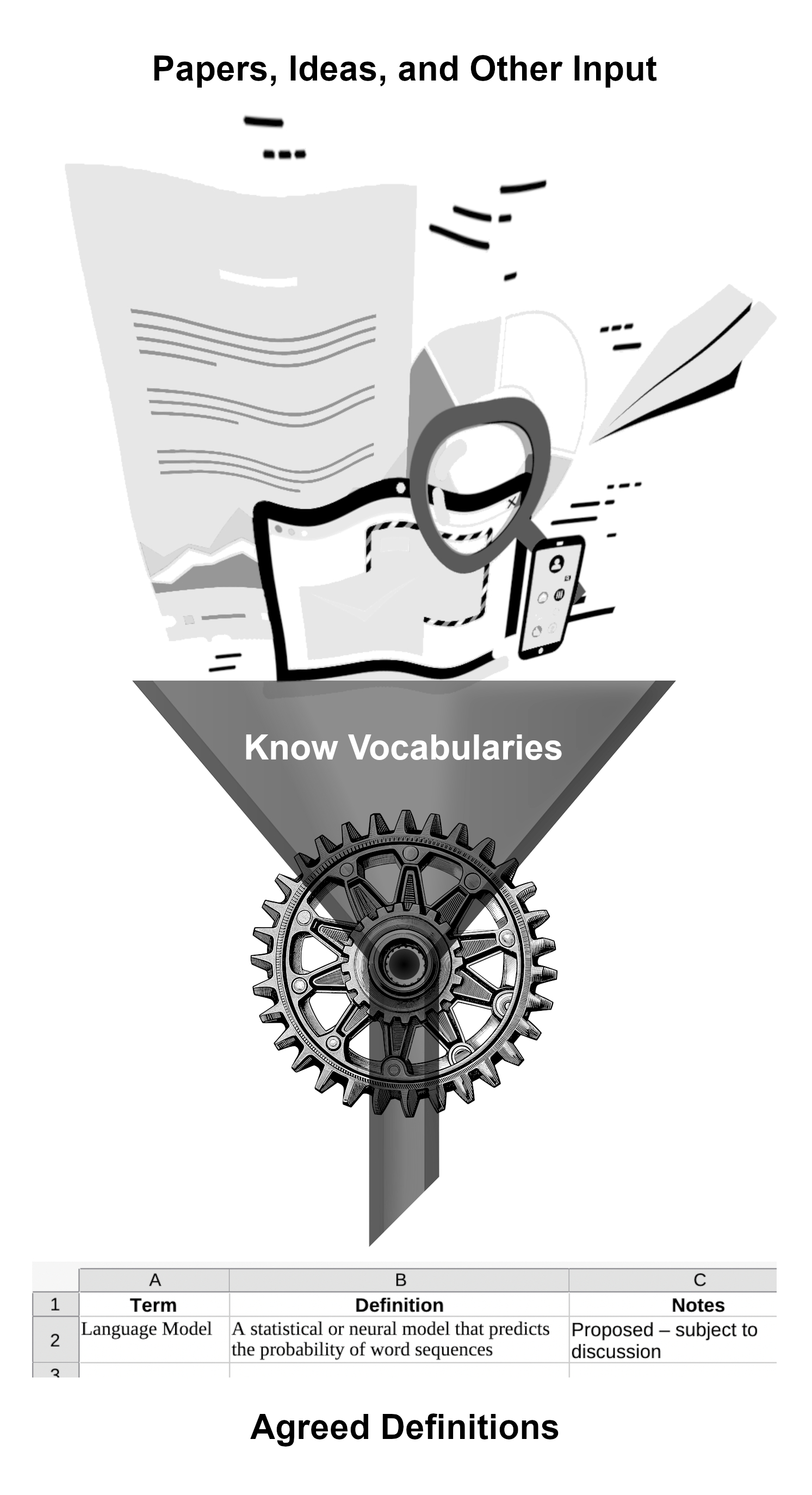 1. Seed Term Extraction
One or more researchers log in to the web service and upload introductory project Word documents and baseline HTML literature pages. The system automatically extracts a list of candidate key concepts and terms from the text. The researchers annotate the candidate entries and filter out irrelevant terms, to form the initial vocabulary baseline.
2. Defining the Dictionary
The researchers collaboratively refine and add to the terms and definitions. All workers have access to the same central list of definitions. They can annotate proposed changes and additions, while working individually, through e-mail exchanges, or in the course of web meetings. They can check usage of the terms in research papers and other published material.
3. Dictionary Lifetime
The dictionary remains in place, accessed as a shared resource, for the duration of the research project and follow-on projects. The consensus update process can continue as long as needed. Access permissions can be updated as people join or leave the team.
4. Using the Dictionary
While the main value of the dictionary is to capture consensus among researchers, it can also be useful during the research and when creating published output. Lists of terms can be exported to JSON or CSV files for input into analysis programs or editing software, or can simply be copied and pasted into text editors.
Key Operational Benefits for Researchers
- Accelerate Literature Reviews: Surface and standardize hidden themes across large volumes of text in minutes.
- Universal Data Compatibility: Inject your structured data directly into your analytical pipelines and editing tools using platform-agnostic data formats.
- Ensure Semantic Interoperability: Harmonize your team's research vocabularies with zero setup, installation, or upfront costs.
Build and Curate Your Vocabularies
Subscribe
For a trial period, we are offering a free 3-months subscription to Know Vocabularies
Free Demo
Upload a document to analyse uses of one of our sample vocabularies - or of your own vocabulary.
About Know Vocabularies and Lacibus
At Lacibus, we believe that being able to harness information and turn it into knowledge is key to success. We provide cutting-edge technology solutions to help teams and individuals organize, manage, and share knowledge. With our expertise, we have developed a solution that provides the latest in machine learning algorithms to make sense of the vast amounts of information available online. Our technology helps users cut through the noise and identify the most relevant and valuable content, saving them time and effort. We are passionate about our work and are dedicated to providing the best solutions for our customers.

Contact us today to organize your information and streamline your research.